St Editha's Crypt

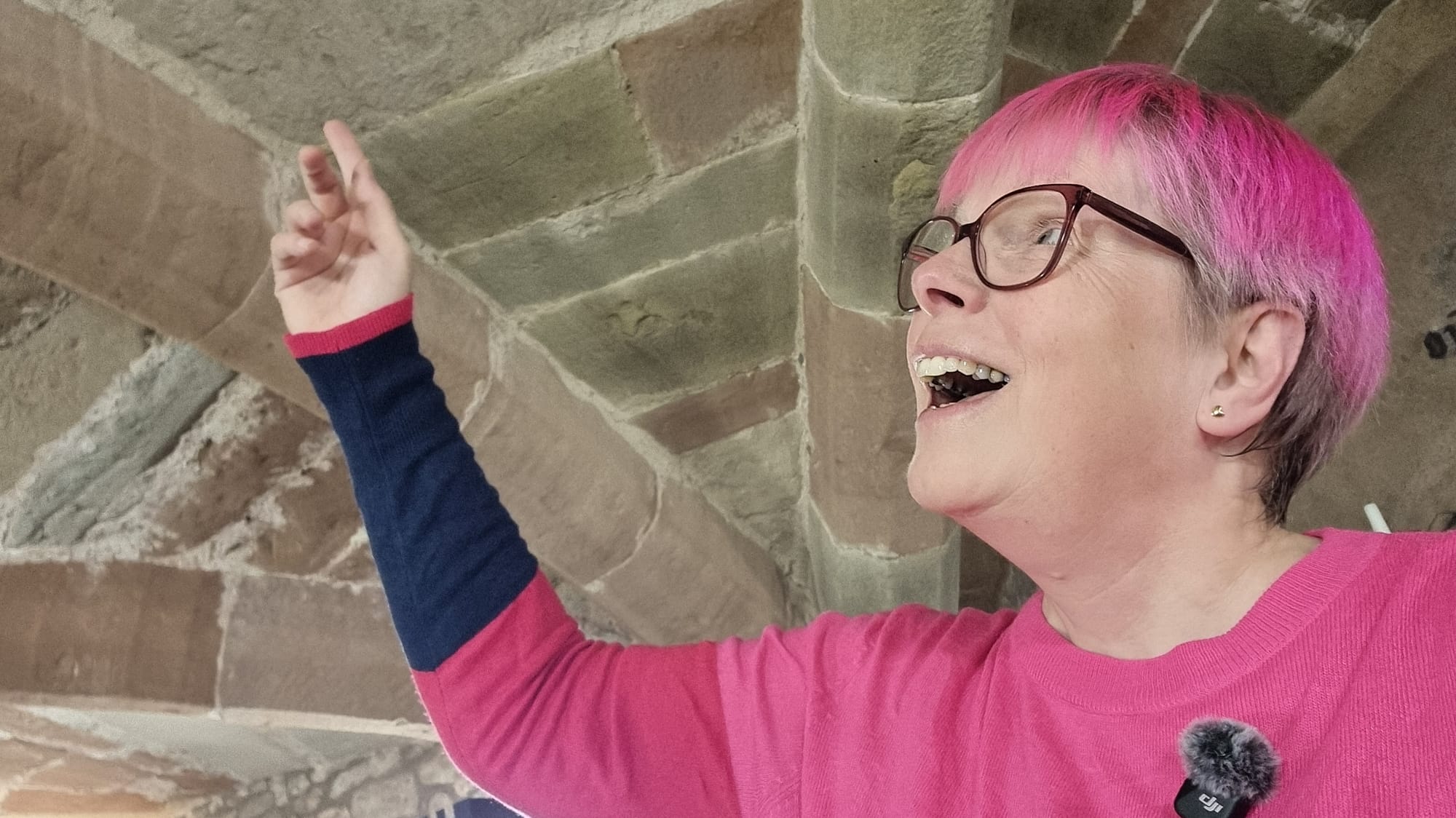
This week I went down into the Crypt at St Editha’s in Tamworth, to have a look around, and learn about the history of its amazing charnel house. You can watch the video on YouTube or read my research below.
There have been churches on the same site in the centre of Tamworth for over a thousand years. The first was destroyed by the Danes. The second was built by Aethelflaed and was again destroyed by the Danes. The third church was built in Saxon times by King Edgar. It was named St Editha after Edgar’s aunt and it probably stood on the site of the present-day north aisle. The Crypt dates from the same era. It was dug in the graveyard to the south of the church. So, what was it used for? One theory is that it started out as a family vault for a wealthy nobleman. Another suggestion is that a chapel was built over it, to perform services for the dead, or perhaps to act as a mortuary, storing bodies in coffins, while they awaited burial.
In May 1345, most of Tamworth, including the church, was destroyed in a huge fire. The church was rebuilt and completed in 1369. This is the fourth church, the one we know today. Most historians seem to agree that this was when the Crypt was incorporated into the church. The original entrance was probably under the south porch, which no longer exists. For the next 500 years or so, the only way in was via a trap door and along a long narrow corridor. Here is the door to the Crypt as it looked in 1846. The door today is the same one, but thankfully, we can reach it via the stairs behind the café.
Today there is electric lighting in the Crypt, but originally the only light came from two small square splayed windows, level with the surface of the Churchyard. The Crypt is divided into four bays by octagonal piers, but today the fourth bay is walled off to form a cloakroom. The original altar was down at the far end of the Crypt, but now the altar table is set up in the second bay of the north wall. On the wall above the altar, there’s an ancient Latin inscription, painted on the plaster. Sorry about the reflections, the art is protected under a sheet of glass. This inscription probably dates back to the fourteenth century. It says, “O rich lord, you will not live forever. Do good while you live, if you want to live after death.” Under this, in large letters, it says, “Have mercy, Jesus Christ.”
The walls, which are made of ragstone, used to be limewashed for sweetness and sanitation. The vaulted roof we see today is not the original; it used to have a much steeper pitch. The stonemason Henry Mitchell believed that the height was reduced in the 14th century, when the new south aisle was built above it. Between the ribs of the groining, the stonemasons reused coffin lids and flat sepulchral grave markers to make the roof. Some of these are carved with ornamentation and ancient symbols. For many years these slabs were thought to be Saxon, and one of them was rumoured to be from a crusader’s coffin. But in 1926, Henry Mitchell decided that the carvings were done in the late 12th century at the very earliest. Only one of the church’s stone coffins has survived. You can see it in the north aisle, near the entrance to the Comberford chapel. I wonder whether this is the one which Henry Mitchell wrote about, saying that he found it in the church foundations, “under the figure of St George”, where he left it undisturbed.
“But where are the bones you promised?” I hear you ask. Well, in the past, when a churchyard filled to capacity, they moved the older bones into an ossuary or a charnel house to make space for new burials. Sometimes they were organised on shelves or in chests, but often they were stacked in piles. Today, as far as I know, there are only two remaining ossuaries in the UK: this one in Rothwell, and this one in Hythe.
So, as Henry Mitchell wrote, “The Crypt became a charnel house, where the great Leveller reigned supreme. There, Quality and Poverty met on equal terms. In the church they had their distinctive cubicles; in the Crypt, a common heap.”
People often say that the Crypt was used as a plague pit, and there were certainly several outbreaks of plague in Tamworth during the Middle Ages and Elizabethan times. But I have found no evidence that the Crypt was ever a plague pit, and it was more likely that Tamworth used a burial pit outside the town, to prevent the spread of infection. Another rumour which circulated for centuries was that many of the bones were brought here from an ancient battlefield. Once again, there is no documentary or archaeological proof for this story.
Charles Ferrers Palmer tells us that Marquis Townshend, the Earl of Leicester, who died in 1811, contemplated converting the Crypt into a family vault, but he was thwarted by the fact that there was nowhere to put all the bones. From 1807 to 1809, extensive repairs were carried out at the church, including the replacement of the entire floor. Charles wrote that the Crypt narrowly escaped demolition during these works. In the end, the church decided to keep the Crypt, and raise part of the south aisle floor instead.
In 1834, Colonel Dyott’s Diary confirms that the Crypt was still used. He wrote:
“A human skeleton was discovered in Hopwas Hays by some labourers. […] The mouldering remains were therefore conveyed to the bone-house in Tamworth Church, and there deposited.”
In 1844 two visitors explored the Crypt. They were Francis Paul Palmer, a Surgeon from Walsall, and Alfred Henry Forrester, an illustrator who worked under the pen name Alfred Croquill. Their guide was a Mr Jones, who I believe was Henry Jones, the Parish Clerk. He told Francis and Alfred that the pile of bones extended a full fourteen yards to the far end of the Crypt, and that most of them had come from the churchyard, although some might have come from the church floor during renovations.
Here’s Alfred’s sketch of the Crypt in the Pictorial Times (which was printed in reverse!) One of the windows and the inscription on the north wall are completely hidden by the bones.

Francis wrote: “The light peers into the solemn space by a narrow window, half buried in earth and wall, upon a mound, or rather a stack, of human bones. The effect is striking. The beaming rays from the world of quick mortality above, fall upon the relics of the unremembered.”
Here’s a verse of Alfred’s poem:
Under the ground dim arches twine their Gothic ribs of stone,
And a timid light falls tremblingly upon walls of human bone.
The sweet cool rays from a living world through the hollowed window peep,
And the chime, the knell of the turret bell, lulls every ghost to sleep.
In 1845, the year after Francis and Alfred’s visit, Charles Ferrers Palmer wrote a text book on the History of the Town and Castle of Tamworth. Here’s the drawing which illustrates his description of the Crypt. He wrote,
“The obscurity of the place is so great, that for some time, the visitor descending from full daylight into this damp and dismal abode of the dead cannot discern its full proportions. […] The floor seems once to have been paved with encaustic tiles, from the fragments which we have found in the earth. The bones are stacked up in very regular order, occupy the whole of the east end, and extend a little more than half along the vault. […] They have for years past increased very slowly. Concerning the east end of the Crypt […] it was believed that from it, a long subterraneous passage communicated with the Castle. The Author and his brother, have, several times, explored the farthest recess of this dreary vault. […] We found nothing there, except the remains of the ancient altar; the stone slab of which is gone. The bones at the end are so rotten, that they crumbled to pieces beneath our weight. We were unable to examine the floor at the base of the altar, there being no room to stow away the bones. In spite of all our efforts, they returned to our feet; and their dull clatter seemed a reproach to us, for disturbing their long and quiet repose in the sacred place.”
The bones were still there in 1869, when the Nuneaton Advertiser reported:
“… the bones occupy the whole of the east end and extend more than half along the vault; there must be the bones of some thousands of persons. […] In the alterations in the church, the vault will be required for the heating apparatus, and the bones are being removed to a large pit which has been made in the old graveyard, about 30 feet square and ten feet deep, where they will shortly be placed. […] Great interest is shown in the removal of the bones, large numbers of persons being present as witnesses.”
I have not managed to identify where in the graveyard this pit was dug. At some point, I need to double check the faculties and plans in the Staffordshire Archives, just in case I missed one, but I don’t think I did. Landscaping and improvements to the churchyard between 1873 and 1874 involved “slightly disturbing and removing some of the coffins”, but no mention was made of the charnel-pit.
The Church Accounts of 1877 confirm that the new furnace was successfully installed. This had made it necessary to create a new entrance to the Crypt, so the trap door had been changed to staircase.
There is now a gap in the history of the Crypt, punctuated only by the installation of a replacement boiler in 1903. In 1934, the Vicar called the use of the Crypt as a boiler room a profanity. He dreamed that one day a benefactor would fund the removal of the heating apparatus, so the Crypt could be restored as a little chapel.
In 1935, Henry Mitchell wrote a history of the Church, followed swiftly by a history of the Town and its Castle. The Crypt features in both books. Henry wrote that over the past ten years he had been taking rubbings and impressions of the flat stones in its roof, one of which was illustrated by the architect Mr J H Beckett and included in the book. Henry expressed concern that during the renovations, the Crypt’s protective limewash had been removed, and the fumes from the boiler were now eating away at the stone slabs and coffin lids. Henry proposed that the Crypt could be converted into a museum, but nothing was done.
The next landmark in the Crypt’s history was the Second World War. The Crypt was one of many sites pressed into service as a public shelter.
In April 1977, the Vicar announced that the parochial church council had decided to convert the Crypt into a refectory. The £7,000 project, was led by the church architect, Mr Ronald Sims. In February 1978, the Bishop of Lichfield conducted the official reopening ceremony and blessing. In his address, he congratulated the church on the imaginative restoration. After the evening service, ladies of the church served refreshments in the newly restored Crypt. Within a few months, the Crypt was fully operational, serving light refreshments for functions and church services. The Vicar hoped it would also be used as a meeting place for young people and others connected with the church. And that’s exactly what happened.
For many years the Crypt was the venue for Mother’s Union meetings; then in 1992, a live music club called the Bolt Hole opened in the Crypt. The house band played a variety of styles from rock to reggae. Founder member Alex Scott explained why it was good for the town, “It’s revolutionary in that it cares about individuals and is committed to meeting the spiritual and inner needs of the people of Tamworth.”
Sometime around 2010, the Crypt was closed for health and safety reasons, but since 2022 the church has undergone a programme of restoration, and the Crypt has been brought back into use as an intimate chapel and meeting place. It may not be the museum that Henry Mitchell once envisaged, but I imagine that the Crypt makes an excellent venue for reflection, community, peace and healing.